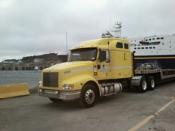
Big kitty CATs
#71
 12-24-2008, 01:18 PM

I averaged ~6.8 or so last summer. My last 3 fills were 6.2, 5.9, 5.7. This is 80,000 lbs gross south on I81 and 33,000 headed north. I think there is more blending as the winter goes along.
I'm not convinced that the aero trucks are a guaranteed mileage maker. Some of those things are heavy pigs. And they all have high rise bunks. I think a flat bed guy could get the same mileage in a 379 as he could in an aero truck. He might have to drive slower though. I'd like to buy an old mechanical 359 flat top and give it a try.  and I also drove empty for some 130 miles between Laredo, TX and Pharr, TX. I keep RPMs at 1300-1325. With the speed of 59 mph, my fuel mileage for the past 1000 mi has been 7.0 mpg. I agree with the flatbeds saving fuel - my 53' dry van trailer catches a lot of wind, even when I'm empty. and I also drove empty for some 130 miles between Laredo, TX and Pharr, TX. I keep RPMs at 1300-1325. With the speed of 59 mph, my fuel mileage for the past 1000 mi has been 7.0 mpg. I agree with the flatbeds saving fuel - my 53' dry van trailer catches a lot of wind, even when I'm empty.
__________________
Watch my YouTube videos
#72
12-25-2008, 03:03 AM
Pulling a tank at 79,000 running 62mph I can get 6.2 with my 379,better in the summer.
__________________
"I love college football. It's the only time of year you can walk down the street with a girl in one arm and a blanket in the other, and nobody thinks twice about it." --Duffy Daugherty 
#73
12-26-2008, 11:45 AM
I think aerodynamic factor is overestimated in trucks. It's all in how close you stay to your "sweet spot" RPM. Classic trucks get more quality air because of outside air breathers, and according to Kenworth website these breathers only increase the annual fuel bill by 1%-2%.
__________________
Watch my YouTube videos
#74
12-26-2008, 12:21 PM
Running 58mph? Yes. But try to run 75-80mph, you'll see the difference.
__________________
Pessimist,- is just well informed optimist!
#75
12-26-2008, 12:25 PM
I think aerodynamic factor is overestimated in trucks. It's all in how close you stay to your "sweet spot" RPM. Classic trucks get more quality air because of outside air breathers, and according to Kenworth website these breathers only increase the annual fuel bill by 1%-2%.
I think the opposite. Aerodynamics affect more MPG then the "sweet spot" ever will. I remember doing a test in North Dakota during stable winds. Going just 2-3 mph faster affected mpg much more then going from 1300 to 1900 rpms. The horsepower required to maintain speed increases exponentially with speed. The most rpms will affect mpg is 3-4%. All aerodynamic trucks grab outside air as well, at least the ones I've seen. Having the filter inside or outside won't change a thing.
#76
12-26-2008, 02:49 PM
From a physics standpoint, maintaining good fuel economy means having as little waste as possible. When you have to brake to maintain speed going down a hill, you are wasting fuel. If your truck hits the bottom of the hill at a significantly faster speed than your truck attacked the hill from, you are wasting fuel. It's a fundamental fact here that moving faster is less efficient due to increased wind resistance. Therefore, it can be said that if you achieved a higher speed, you put in more energy to get it that fast. The best MPGs possible would result from efficiently cresting a hill at a velocity slow enough that, at the bottom of the hill, you are doing your original speed you started from; this means you did NOT waste energy by braking, or excessive wind resistance through high speeds.
Also, more horsepower can result in better fuel economy if it allows you to climb a hill without downshifting. Your truck only generates the horsepower that it needs to maintain a given speed, so even if you have a 600hp engine, it will only burn enough fuel to create the ponies needed for the given speed, load and grade. Those extra horses are only generated when the conditions or driving habits or the driver demand that they be produced to make the engine perform as demanded. Notwithstanding how a truck is spec’d, it always takes more fuel to drive and / or accelerate faster. Getting back to your physics, the power required to overcome air resistance increases roughly by the cube of the speed. The faster you drive the more fuel (by a power of three, or to be more precise, 2.6)it takes to overcome the drag. I know that some trucks because of how they are spec’d will be more efficient at 70 mph than they are at 60mph, but a truck properly spec’d to run at 60mph will always get better fuel economy than a truck spec’d to run 70, assuming that all other variables are constant.
__________________
"The Breakfast of Champions isn't cereal, it's the competition!" - "Success is how high you bounce when you hit bottom." - "An appeaser is one who feeds a crocodile, hoping it will eat him last."
#77
12-26-2008, 03:05 PM
I think aerodynamic factor is overestimated in trucks. It's all in how close you stay to your "sweet spot" RPM. Classic trucks get more quality air because of outside air breathers, and according to Kenworth website these breathers only increase the annual fuel bill by 1%-2%.
__________________
"The Breakfast of Champions isn't cereal, it's the competition!" - "Success is how high you bounce when you hit bottom." - "An appeaser is one who feeds a crocodile, hoping it will eat him last."
#78
12-27-2008, 09:08 AM
Also, those breathers in the grand scheme of things are nothing when compared to the effect of drag on the entire truck at 70 mph. Also, 2% increase in fuel cost at $4 per gallon, 6 mpg, and 140k miles a year is almost $1900 a year, or nearly $10,000 over five years. I hope they're pretty, because those cans are going to be awfully expensive.
110,000 / 6 mpg = 18333 gal x 2.45 = $44,916 REBATE: 110,000 mi x 0.15 = $16,500 Annual actual cost of fuel: 44,916 - 16500 = $28,416. 2% mpg loss of $28,416 is $569/year or $47/mo; not $1,900/year. Outside air breathers provide MORE air and this air is COLDER which actually improves fuel economy compared to trucks with air filters hidden near the engine block (check pittsburgpower.com). Classic trucks also command higher resale value and are easier to get rid of. For people who drive SLOW, it doesn't matter that much what kind of truck you drive. I'd say the most important factor is the weight of the load, then - the truck spec's.
__________________
Watch my YouTube videos
#79
12-27-2008, 11:29 AM
I remember chatting with Bruce about that, and I asked him if he had figures at the turbo inlet that showed he was correct. He didn't. It's simply opinion, not fact. Again, I don't see why having the filter inside the hood would make a difference. Both are grabbing the air from the outside.
#80
12-27-2008, 01:40 PM
A question for people with CatC15
In your experience, what RPM gives you best fuel mileage at cruise with the CAT when loaded? Thanks.
__________________
Watch my YouTube videos |