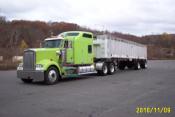
Big kitty CATs
#92
 12-31-2008, 04:56 AM

If that is true, check your fuel economy driving into a 30mph headwind, and then turn around and see what it is running with a 30 mph tail wind. Driving into that 30mph headwind, I might get 5.5 mpg. Running with the tail wind I could get as much as 8 mpg. Take it from a physics phan, above 45mph, wind resistance is by far the largest factor in fuel consumption. If you don't want to take it from me, Google "wind resistance fuel economy" and see what others who are probably smarter than me have to say. Find one trustworthy source that agrees with you (other than longhood owner operators who are trying to make themselves feel better about driving a concrete block) and get back to me. Also, those breathers in the grand scheme of things are nothing when compared to the effect of drag on the entire truck at 70 mph. Also, 2% increase in fuel cost at $4 per gallon, 6 mpg, and 140k miles a year is almost $1900 a year, or nearly $10,000 over five years. I hope they're pretty, because those cans are going to be awfully expensive.
No my point was more about drag coefficents. 1. what is the drag coefficient of a Columbia vs say a FLD120 flat top, with ground effects & without stacks? 2. how does that lesser drag theoretically equate to fuel mileage, with all other variables equal? 3. when pulling a flat or a tanker, does an aero truck with a high rise bunk even have a lesser drag coefficient than a long hood with a flat bunk? If it does, I suggest that it may be minimal. I guess I'm suggesting that a long hood with a flat top will get similar or possibly even better mileage pulling a flat or a tanker than a aero high rise pulling the same type of trailer. Now, let's take this one step further and compare long hood hi-rise to aero-hi rise. In this case, it safe to say that the only real difference in the drag coefficient is coming from the sloped "anteater" hood? How much can that hood really effect fuel mileage?
#93
12-31-2008, 05:21 AM
It depends on a speed you're traveling. Even windshield wipers affect drag some how, or CB antennas....
And the faster you go, then more is the difference. But in general, I'd guess the difference is around 0.5 mpg average, assuming all other things, are equal...
__________________
Pessimist,- is just well informed optimist!
#94
12-31-2008, 02:48 PM
No my point was more about drag coefficents.
1. what is the drag coefficient of a Columbia vs say a FLD120 flat top, with ground effects & without stacks? 2. how does that lesser drag theoretically equate to fuel mileage, with all other variables equal? 3. when pulling a flat or a tanker, does an aero truck with a high rise bunk even have a lesser drag coefficient than a long hood with a flat bunk? If it does, I suggest that it may be minimal. I guess I'm suggesting that a long hood with a flat top will get similar or possibly even better mileage pulling a flat or a tanker than a aero high rise pulling the same type of trailer. Now, let's take this one step further and compare long hood hi-rise to aero-hi rise. In this case, it safe to say that the only real difference in the drag coefficient is coming from the sloped "anteater" hood? How much can that hood really effect fuel mileage?
__________________
"The Breakfast of Champions isn't cereal, it's the competition!" - "Success is how high you bounce when you hit bottom." - "An appeaser is one who feeds a crocodile, hoping it will eat him last." Last edited by Musicman; 12-31-2008 at 02:50 PM.
#95
01-01-2009, 07:25 AM
Tankers and aerodynamics are non existent, don't know why everybody thinks they are.
Take a real close look at this fine specimen, notice how the front fender scoops up air, also notice how the trailer axles stick out, and the ladder, look at the ribs and the box on top for the dome, and all the other thing that interupt air flow. While this is an uninsulated tank, the only difference is the smooth polished appearance of the outer insulation. NO aerodynamic advantages NONE, I get the same fuel mileage as a van, only thing is the cross winds SOMETIMES don't effect me, thats it 
Last edited by Maniac; 01-01-2009 at 09:46 AM.
#96
01-01-2009, 07:34 AM
just use the img and quote tags
__________________
"I love college football. It's the only time of year you can walk down the street with a girl in one arm and a blanket in the other, and nobody thinks twice about it." --Duffy Daugherty 
Last edited by mike3fan; 01-01-2009 at 10:10 AM.
#98
01-01-2009, 08:55 AM
I don't either I just enter them myself [img]pic[/img] [ quote]text[/quote]
__________________
"I love college football. It's the only time of year you can walk down the street with a girl in one arm and a blanket in the other, and nobody thinks twice about it." --Duffy Daugherty
#100
01-02-2009, 06:26 AM
How much do you really think that air heats up in the fraction of a second that it spends inside that under-hood air cleaner before it is moved into the intake? I’m sure you really don’t know and neither do I, but a tiny amount of common sense and a teensy amount of science knowledge would allow us to deduce that it couldn’t be more than a degree, if that much.
__________________
The reason I'm a narcissist is cause everyone else is so lame. |