Hours of Service
#91
 02-25-2007, 09:59 AM

Originally Posted by golfhobo
Orangetxguy: Although I commend your cut and paste skills, most of that was unnecessary. Most of us have read it. However, that is NOT the full volume of the HOS regs.
You said:
Also...where in that paragraph does it say anything about a break in your sleeper berth or off duty, extends your 14 hour work period? It does not. From the time you begin your "WORK DAY" you have 14 hours before you MUST take 10 consecutive hours OFFDUTY.
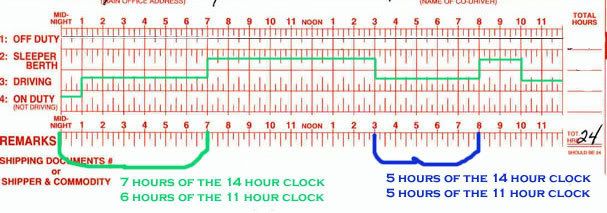
Your statement that I highlighted is incorrect. In fact, it is a common mistake CAUSED by the short form of the rules that you quoted at the top of your post. The fmcsa continues to incorrectly use the word "consecutive" in reference to the 10 hour break. This causes A LOT of confusion. Dawn and I, and the Rev and others, have CORRECTLY quoted and/or explained the regs concerning the 14 hour rule and how the 8 hour S/B time is OFF THE CLOCK. It's very simple. You can drive all 11 at one time and THEN take a full 10 hours off "consecutively." OR, you can drive part of the 11, take either a 2 hour or 8 hour break, then drive the remaining hours and then take the "corresponding" break. An 8 hour S/B break is ALWAYS "off the clock" (when "splitting.) Therefore, you CAN still be driving after the 14th hour after coming "on duty" (following a 10 hour break or 34 hour reset if you take the 8 hour break first. There's much MORE to this, and I'll be glad to help you understand it if you want. I'm just pointing out that your statement is incorrect, for now. Please do explain to me, as well as other's, how taking an 8 hour sleeper-berth break, extends the 14 hour rule. I went to the logging link that Dawn posted earlier. I looked over those log's, as they are posted by FMCSA. I noticed that after the first example, the following samples all contain 11 hour and 14 hour log violations, some using the 8 hour sleeper-berth split. I tried the "cut&paste" thing with the log graph's, but I could not get the graph's to copy over, just the text. FYI... I too was trained to "teach" proper logging methods. I was trained to teach both OTR logging as well as use of "Oilfield Exemptions", and the problems caused by switches in service (from oilfield to OTR, or OTR to Oilfield), without properly counting "hours of service", prior to service change. But...that was in 1980. As for the short form of the rules which I "cut&pasted". I cut and pasted the rules from the FMCSA website. I read the rules...I re-read the rules. I understand how you are saying that you can work a portion of 14 hours, then take an 8 hour sleeper-berth, then continue driving. Where I lose my cohesion it seems, would be after re-starting work (driving), at the end of the 8 hour sleeper-berth. If you log one hour on-duty not driving, (line 4), move to line 3 (on-duty driving) drive for 6 hours, then move to line 2 (sleeper-berth) and log 8 hours in sleepr-berth, return to line 3 (on-duty driving), "How many hours may you drive, before violating the 14 hour time limit"?
__________________
Space...............Is disease and danger, wrapped in darkness and silence! :thumbsup: Star Trek2009
#92
02-25-2007, 10:27 AM
Originally Posted by Orangetxguy
I'm gonna bite.
Please do explain to me, as well as other's, how taking an 8 hour sleeper-berth break, extends the 14 hour rule.
If you log one hour on-duty not driving, (line 4), move to line 3 (on-duty driving) drive for 6 hours, then move to line 2 (sleeper-berth) and log 8 hours in sleepr-berth, return to line 3 (on-duty driving), "How many hours may you drive, before violating the 14 hour time limit"?
#93
02-25-2007, 10:31 AM
Originally Posted by Dawn
Originally Posted by Orangetxguy
Lot's of discussion...lot's of opinion...lot's of name calling...over something that "IF YOU GET IT WRONG", and YOU are involved in a serious accident.....YOU ARE GOING TO JAIL.
Here is what I found at the FMCSA website. The "Short" version is on TOP, the entire regulation follows. Summary of the New Hours-of-Service Regulations Effective October 1, 2005 **The following table summarizes only the HOS rule changes. Be sure to consult the Driver's Brochure for a more complete explanation of HOS rules. HOURS-OF-SERVICE RULES 2003 Rule Property-Carrying CMV Drivers Compliance Through 09/30/05 2005 Rule Property-Carrying CMV Drivers Compliance On & After 10/01/05 May drive a maximum of 11 hours after 10 consecutive hours off duty. NO CHANGE May not drive beyond the 14th hour after coming on duty, following 10 consecutive hours off duty. NO CHANGE May not drive after 60/70 hours on duty in 7/8 consecutive days. A driver may restart a 7/8 consecutive day period after taking 34 or more consecutive hours off duty. NO CHANGE Commercial Motor Vehicle (CMV) drivers using a sleeper berth must take 10 hours off duty, but may split sleeper-berth time into two periods provided neither is less than 2 hours. CMV drivers using the sleeper berth provision must take at least 8 consecutive hours in the sleeper berth, plus 2 consecutive hours either in the sleeper berth, off duty, or any combination of the two. Passenger-carrying carriers/drivers are not subject to the new hours-of-service rules. These operations must continue to comply with the hours-of-service limitations specified in 49 CFR 395.5. ** New Short-Haul Provision Drivers of property-carrying CMVs which do not require a Commercial Driver's License for operation and who operate within a 150 air-mile radius of their normal work reporting location: May drive a maximum of 11 hours after coming on duty following 10 or more consecutive hours off duty. Are not required to keep records-of-duty status (RODS). May not drive after the 14th hour after coming on duty 5 days a week or after the 16th hour after coming on duty 2 days a week. Employer must: Maintain and retain accurate time records for a period of 6 months showing the time the duty period began, ended, and total hours on duty each day in place of RODS. Drivers who use the above-described short-haul provision are not eligible to use 100 air-mile provision 395.1(e) or the current 16-hour exception in 395.1(o). Related Links HOS News Release Administrator Sandberg Remarks HOS Regulations THE Regulation...cut from the FMCSA website. {§395.8 Driver's record of duty status. (a) Except for a private motor carrier of passengers (nonbusiness), every motor carrier shall require every driver used by the motor carrier to record his/her duty status for each 24 hour period using the methods prescribed in either paragraphs (a)(1) or (2) of this section. (a)(1) Every driver who operates a commercial motor vehicle shall record his/her duty status, in duplicate, for each 24 hour period. The duty status time shall be recorded on a specified grid, as shown in paragraph (g) of this section. The grid and the requirements of paragraph (d) of this section may be combined with any company forms. The previously approved format of the Daily Log, Form MCS 59 or the Multi day Log, MCS 139 and 139A, which meets the requirements of this section, may continue to be used. (a)(2) Every driver who operates a commercial motor vehicle shall record his/her duty status by using an automatic on board recording device that meets the requirements of §395.15 of this part. The requirements of §395.8 shall not apply, except paragraphs (e) and (k)(1) and (2) of this section. (b) The duty status shall be recorded as follows: (b)(1) "Off duty" or "OFF." (b)(2) "Sleeper berth" or "SB" (only if a sleeper berth used). (b)(3) "Driving" or "D." (b)(4) "On duty not driving" or "ON." (c) For each change of duty status (e.g., the place of reporting for work, starting to drive, on duty not driving and where released from work), the name of the city, town or village, with State abbreviation, shall be recorded. Note: If a change of duty status occurs at a location other than a city, town, or village, show one of the following: (1) the highway number and nearest milepost followed by the name of the nearest city, town, or village and State abbreviation, (2) the highway number and the name of the service plaza followed by the name of the nearest city, town, or village and State abbreviation, or (3) the highway numbers of the nearest two intersecting roadways followed by the name of the nearest city, town, or village and State abbreviation. (d) The following information must be included on the form in addition to the grid: (d)(1) Date; (d)(2) Total miles driving today; (d)(3) Truck or tractor and trailer number; (d)(4) Name of carrier; (d)(5) Driver's signature/certification; (d)(6) 24 hour period starting time (e.g., midnight, 9:00 a.m., noon, 3:00 p.m.); (d)(7) Main office address; (d)(8) Remarks; (d)(9) Name of co driver; (d)(10) Total hours (far right edge of grid); and (d)(11) Shipping document number(s), or name of shipper and commodity. (e) Failure to complete the record of duty activities of this section or §395.15, failure to preserve a record of such duty activities, or making of false reports in connection with such duty activities shall make the driver and/or the carrier liable to prosecution. (f) The driver's activities shall be recorded in accordance with the following provisions: (f)(1) Entries to be current. Drivers shall keep their record of duty status current to the time shown for the last change of duty status. (f)(2) Entries made by driver only. All entries relating to driver's duty status must be legible and in the driver's own handwriting. (f)(3) Date. The month, day and year for the beginning of each 24 hour period shall be shown on the form containing the driver's duty status record. (f)(4) Total miles driving today. Total mileage driven during the 24 hour period shall be recorded on the form containing the driver's duty status record. (f)(5) Commercial motor vehicle identification. The driver shall show the number assigned by the motor carrier or the license number and licensing State of each commercial motor vehicle operated during each 24-hour period on his/her record of duty status. The driver of an articulated (combination) commercial motor vehicle shall show the number assigned by the motor carrier, or the license number and licensing State of each motor vehicle used in each commercial motor vehicle combination operated during that 24-hour period on his/her record of duty status. (f)(6) Name of motor carrier. The name(s) of the motor carrier(s) for which work is performed shall be shown on the form containing the driver's record of duty status. When work is performed for more than one motor carrier during the same 24-hour period, the beginning and finishing time, showing a.m. or p.m., worked for each motor carrier shall be shown after each motor carrier's name. Drivers of leased commercial motor vehicles shall show the name of the motor carrier performing the transportation. (f)(7) Signature/certification. The driver shall certify to the correctness of all entries by signing the form containing the driver's duty status record with his/her legal name or name of record. The driver's signature certifies that all entries required by this section made by the driver are true and correct. (f)(8) Time base to be used. (f)(8)(i) The driver's duty status record shall be prepared, maintained, and submitted using the time standard in effect at the driver's home terminal, for a 24 hour period beginning with the time specified by the motor carrier for that driver's home terminal. (f)(8)(ii) The term "7 or 8 consecutive days" means the 7 or 8 consecutive 24 hour periods as designated by the carrier for the driver's home terminal. (f)(8)(iii) The 24 hour period starting time must be identified on the driver's duty status record. One hour increments must appear on the graph, be identified, and preprinted. The words "Midnight" and "Noon" must appear above or beside the appropriate one hour increment. (f)(9) Main office address. The motor carrier's main office address shall be shown on the form containing the driver's duty status record. (f)(10) Recording days off duty. Two or more consecutive 24 hour periods off duty may be recorded on one duty status record. (f)(11) Total hours. The total hours in each duty status: off duty other than in a sleeper berth; off duty in a sleeper berth; driving, and on duty not driving, shall be entered to the right of the grid, the total of such entries shall equal 24 hours. (f)(12) Shipping document number(s), or name of shipper and commodity shall be shown on the driver's record of duty status. (g) Graph grid. The following graph grid must be incorporated into a motor carrier recordkeeping system which must also contain the information required in paragraph (d) of this section. FIGURE 1. - GRAPH GRID —VERTICALLY FIGURE 2. - GRAPH GRID —HORIZONTALLY (h) Graph Grid Preparation. The graph grid may be used horizontally or vertically and shall be completed as follows: (h)(1) Off duty. Except for time spent resting in a sleeper berth, a continuous line shall be drawn between the appropriate time markers to record the period(s) of time when the driver is not on duty, is not required to be in readiness to work, or is not under any responsibility for performing work. (h)(2) Sleeper berth. A continuous line shall be drawn between the appropriate time markers to record the period(s) of time off duty resting in a sleeper berth, as defined in §395.2 (If a non-sleeper berth operation, sleeper berth need not be shown on the grid.) (h)(3) Driving. A continuous line shall be drawn between the appropriate time markers to record the period(s) of driving time as defined in §395.2. (h)(4) On duty not driving. A continuous line shall be drawn between the appropriate time markers to record the period(s) of time on duty not driving specified in §395.2 (h)(5) Location - Remarks. The name of the city, town, or village, with State abbreviation where each change of duty status occurs shall be recorded. Note: If a change of duty status occurs at a location other than a city, town, or village, show one of the following: (1) the highway number and nearest milepost followed by the name of the nearest city, town, or village and State abbreviation, (2) the highway number and the name of the service plaza followed by the name of the nearest city, town, or village and State abbreviation, or (3) the highway numbers of the nearest two intersecting roadways followed by the name of the nearest city, town, or village and State abbreviation. (i) Filing driver's record of duty status. The driver shall submit or forward by mail the original driver's record of duty status to the regular employing motor carrier within 13 days following the completion of the form. (j) Drivers used by more than one motor carrier. (1) When the services of a driver are used by more than one motor carrier during any 24 hour period in effect at the driver's home terminal, the driver shall submit a copy of the record of duty status to each motor carrier. The record shall include: (j)(1)(i) All duty time for the entire 24 hour period; (j)(1)(ii) The name of each motor carrier served by the driver during that period; and (j)(1)(iii) The beginning and finishing time, including a.m. or p.m., worked for each carrier. (j)(2) Motor carriers, when using a driver for the first time or intermittently, shall obtain from the driver a signed statement giving the total time on duty during the immediately preceding 7 days and the time at which the driver was last relieved from duty prior to beginning work for the motor carriers. (k) Retention of driver's record of duty status. (1) Each motor carrier shall maintain records of duty status and all supporting documents for each driver it employs for a period of six months from the date of receipt. (k)(2) The driver shall retain a copy of each record of duty status for the previous 7 consecutive days which shall be in his/her possession and available for inspection while on duty. Note: Driver's record of duty status. The graph grid, when incorporated as part of any form used by a motor carrier, must be of sufficient size to be legible. The following executed specimen grid illustrates how a driver's duty status should be recorded for a trip from Richmond, Virginia, to Newark, New Jersey. The grid reflects the midnight to midnight 24 hour period. FIGURE 3. - GRAPH GRID FILLED IN(midnight to midnight operation) The driver in this instance reported for duty at the motor carrier's terminal. The driver reported for work at 6 a.m., helped load, checked with dispatch, made a pretrip inspection, and performed other duties until 7:30 a.m. when the driver began driving. At 9 a.m. the driver had a minor accident in Fredericksburg, Virginia, and spent one half hour handling details with the local police. The driver arrived at the company's Baltimore, Maryland, terminal at noon and went to lunch while minor repairs were made to the tractor. At 1 p.m. the driver resumed the trip and made a delivery in Philadelphia, Pennsylvania, between 3 p.m. and 3:30 p.m. at which time the driver started driving again. Upon arrival at Cherry Hill, New Jersey, at 4 p.m., the driver entered the sleeper berth for a rest break until 5:45 p.m. at which time the driver resumed driving again. At 7 p.m. the driver arrived at the company's terminal in Newark, New Jersey. Between 7 p.m. and 8 p.m. the driver prepared the required paperwork including completing the driver's record of duty status, driver vehicle inspection report, insurance report for the Fredericksburg, Virginia accident, checked for the next day's dispatch, etc. At 8 p.m., the driver went off duty.} [47 FR 53389, Nov. 26, 1982, as amended at 49 FR 38290, Sept. 28, 1984; 49 FR 46147, Nov. 23, 1984; 51 FR 12622, Apr. 14, 1986; 52 FR 41721, Oct. 30, 1987; 53 FR 18058, May 19, 1988; 53 FR 38670, Sept. 30, 1988; 57 FR 33649, July 30, 1992; 58 FR 33777, June 21, 1993; 59 FR 8753, Feb. 23, 1994; 60 FR 38748, July 28, 1995; 62 FR 16709, Apr. 8, 1997; 63 FR 33279, June 18, 1998]. Related Links Disclaimer Interpretation I tried to cut and paste the log graph for the above...could not get it to transfer...probably my fault. You want to find out how easy it is to screw up your record? Log the way some here are suggesting, miss your math by 1/4 of an hour, then have a serious accident, or just piss off a DOT officer enough for a solid look at your logbook. :shock: :roll: :shock: :roll: If you have questions about how YOU are supposed to fill out you logbook, ask a certifed DOT Officer...the guy's in Tennessee are really good...Ohio isn't bad either....Californina...depends on which scale you are at.....OR ask your company's COMPLIANCE OFFICER for both the Oral explanation, as well as the WRITTEN explanation. I am well known and I am wanted by many companies because they understand I am knowledgable in the Log Regulations! I work very hard in trying to get the correct information out to the drivers in the way they would understand and if they don't yes they need to see someone else! I will try and try until THEY give up! Just some on this board do not understand how much I can help them :lol: I placed astrics to de-note the "short" version, as I "C & P'd" it from the FMCSA website. I added the {} around the HOS regulation, as it was cut and pasted from the FMCSA website. Dawn supplied the smiley faces elsewhere in the text. I read in the short version, after the words NO CHANGE, that "Commercial Motor Vehicle (CMV) drivers, must take 10 hours off duty, but may split sleeper-berth duty into 2 periods, provided neither period is less than 2 hours. CMV drivers must take at least 8 consecutive hours in the sleeper-berth, plus 2 consecutive hours either in sleeper-berth, off duty, or a combination of the 2." That is the regulation, as pertains to 10 consecutive hours off-duty. When you read the full regulation, the portion at the end..the portion inside the [ ], you can see the dates of changes made to the regulations, begining with calender year 1982, ending with calender year 1998. Below is this; which was what I just quoted from. I placed << & >>. to de-note the regulation, as published in 2003 & *** to bracket the changes made in 2005. Summary of the New Hours-of-Service Regulations Effective October 1, 2005 The following table summarizes only the HOS rule changes. Be sure to consult the Driver's Brochure for a more complete explanation of HOS rules. HOURS-OF-SERVICE RULES <<2003>> NO CHANGE ***Commercial Motor Vehicle (CMV) drivers using a sleeper berth must take 10 hours off duty, but may split sleeper-berth time into two periods provided neither is less than 2 hours. CMV drivers using the sleeper berth provision must take at least 8 consecutive hours in the sleeper berth, plus 2 consecutive hours either in the sleeper berth, off duty, or any combination of the two. *** Passenger-carrying carriers/drivers are not subject to the new hours-of-service rules. These operations must continue to comply with the hours-of-service limitations specified in 49 CFR 395.5. New Short-Haul Provision Drivers of property-carrying CMVs which do not require a Commercial Driver's License for operation and who operate within a 150 air-mile radius of their normal work reporting location: May drive a maximum of 11 hours after coming on duty following 10 or more consecutive hours off duty. Are not required to keep records-of-duty status (RODS). May not drive after the 14th hour after coming on duty 5 days a week or after the 16th hour after coming on duty 2 days a week. Employer must: Maintain and retain accurate time records for a period of 6 months showing the time the duty period began, ended, and total hours on duty each day in place of RODS. Drivers who use the above-described short-haul provision are not eligible to use 100 air-mile provision 395.1(e) or the current 16-hour exception in 395.1(o). Related Links HOS News Release Administrator Sandberg Remarks HOS Regulations I still do not SEE where the 14 hour rule is extended by 8 hours in the sleeper berth..so please educate me. :?
__________________
Space...............Is disease and danger, wrapped in darkness and silence! :thumbsup: Star Trek2009
#94
02-25-2007, 10:42 AM
Originally Posted by Orangetxguy
I still do not SEE where the 14 hour rule is extended by 8 hours in the sleeper berth..so please educate me. :?
§395.1 Scope of rules in this part.
(g) Sleeper berths. (g)(1) Property-carrying commercial motor vehicle. (g)(1)(i) In General. - A driver who operates a property-carrying commercial motor vehicle equipped with a sleeper berth, as defined in §§395.2 and 393.76 of this subchapter, (g)(1)(i)(D) Must exclude from the calculation of the 14-hour limit any sleeper berth period of at least 8 but less than 10 consecutive hours.
#95
02-25-2007, 10:47 AM
Originally Posted by Orangetxguy
I'm gonna bite.
Please do explain to me, as well as other's, how taking an 8 hour sleeper-berth break, extends the 14 hour rule.
If you log one hour on-duty not driving, (line 4), move to line 3 (on-duty driving) drive for 6 hours, then move to line 2 (sleeper-berth) and log 8 hours in sleepr-berth, return to line 3 (on-duty driving), "How many hours may you drive, before violating the 14 hour time limit"?
Originally Posted by Rev.Vassago
You can drive for 5 hours more, and then your 11 hours is used up. You have only used 12 hours of your 14 hour clock, but you must log at least 2 more hours off duty (or sleeper berth) before you can drive again. At that point, you can drive for 6 hours before you must take another 8 hour sleeper berth.
__________________
http://www.trukz.com
#96
02-25-2007, 10:49 AM
Originally Posted by Rev.Vassago
Originally Posted by Orangetxguy
I'm gonna bite.
Please do explain to me, as well as other's, how taking an 8 hour sleeper-berth break, extends the 14 hour rule.
If you log one hour on-duty not driving, (line 4), move to line 3 (on-duty driving) drive for 6 hours, then move to line 2 (sleeper-berth) and log 8 hours in sleepr-berth, return to line 3 (on-duty driving), "How many hours may you drive, before violating the 14 hour time limit"?
Mathematicly; 1hr + 6hrs +(-8hrs)+5hrs+2hrs+6hrs = "Legal". :?: :?: :shock: :? :? You can legally work 18 hours in a 28 hour time span, without taking 10 consecutive hours off duty? If so....why did I get hammered at the end of October, due to the fact that I missed a 10 hour break by 1/4 hour? That 1/4 hour, according to JJ Keller & the safety department, placed me over hours on 11, over hours on 14, and degated my 34 hour re-set, which in turn placed me in Hours violation for the entire first week of November. In the 48 hours before my 1/4 hour mistake, I was Off duty for 10 consecutive hours, worked 11 & 1/4 hours, with a 2 hour sleeper-berth period at the 8th hour of work, was off duty for, what turned out to be, 9 & 3/4 hours, worked 9 hours, then took a 34 hour re-set. I looked over my log's after I was called in..and yes..I made that 1/4 hour mistake, which in turn negated my 34-hour re-set, due to being in violation, when I started my re-set.
__________________
Space...............Is disease and danger, wrapped in darkness and silence! :thumbsup: Star Trek2009
#97
02-25-2007, 10:56 AM
Originally Posted by Rev.Vassago
Originally Posted by Orangetxguy
I'm gonna bite.
Please do explain to me, as well as other's, how taking an 8 hour sleeper-berth break, extends the 14 hour rule.
If you log one hour on-duty not driving, (line 4), move to line 3 (on-duty driving) drive for 6 hours, then move to line 2 (sleeper-berth) and log 8 hours in sleepr-berth, return to line 3 (on-duty driving), "How many hours may you drive, before violating the 14 hour time limit"?
In your log that you drew up and scanned.....Why does the 8 hours consecutive stop the clock? What is to prevent a DOT officer from issueing a citation, for exceeding the 14 hour limit, which occured at 2PM on your log graph? Perhaps I am being to literal in my understanding of the regulation, as it is posted on the FMCSA website? 10 hours consecutive hours, really isn't 10 consecutive hours?
__________________
Space...............Is disease and danger, wrapped in darkness and silence! :thumbsup: Star Trek2009
#98
02-25-2007, 11:03 AM
Originally Posted by Colin
Originally Posted by Orangetxguy
I'm gonna bite.
Please do explain to me, as well as other's, how taking an 8 hour sleeper-berth break, extends the 14 hour rule.
If you log one hour on-duty not driving, (line 4), move to line 3 (on-duty driving) drive for 6 hours, then move to line 2 (sleeper-berth) and log 8 hours in sleepr-berth, return to line 3 (on-duty driving), "How many hours may you drive, before violating the 14 hour time limit"?
Originally Posted by Rev.Vassago
You can drive for 5 hours more, and then your 11 hours is used up. You have only used 12 hours of your 14 hour clock, but you must log at least 2 more hours off duty (or sleeper berth) before you can drive again. At that point, you can drive for 6 hours before you must take another 8 hour sleeper berth.
__________________
Space...............Is disease and danger, wrapped in darkness and silence! :thumbsup: Star Trek2009
#99
02-25-2007, 11:23 AM
Originally Posted by Orangetxguy
OK Rev...You are saying, That "8 hours" in the sleeper-berth STOPS the 14 hour clock. That "AFTER" 8 hours a driver may drive again for 5 hours, take a break of "2 hours", then drive again?
Mathematicly; 1hr + 6hrs +(-8hrs)+5hrs+2hrs+6hrs = "Legal". :?: :?: :shock: :? :?
You can legally work 18 hours in a 28 hour time span, without taking 10 consecutive hours off duty?
If so....why did I get hammered at the end of October, due to the fact that I missed a 10 hour break by 1/4 hour? That 1/4 hour, according to JJ Keller & the safety department, placed me over hours on 11, over hours on 14, and degated my 34 hour re-set, which in turn placed me in Hours violation for the entire first week of November.
In the 48 hours before my 1/4 hour mistake, I was Off duty for 10 consecutive hours, worked 11 & 1/4 hours, with a 2 hour sleeper-berth period at the 8th hour of work, was off duty for, what turned out to be, 9 & 3/4 hours, worked 9 hours, then took a 34 hour re-set. I looked over my log's after I was called in..and yes..I made that 1/4 hour mistake, which in turn negated my 34-hour re-set, due to being in violation, when I started my re-set.
Rev..we are playing bouncing examples.
In your log that you drew up and scanned.....Why does the 8 hours consecutive stop the clock? What is to prevent a DOT officer from issueing a citation, for exceeding the 14 hour limit, which occured at 2PM on your log graph?
Perhaps I am being to literal in my understanding of the regulation, as it is posted on the FMCSA website? 10 hours consecutive hours, really isn't 10 consecutive hours?
§395.1 Scope of rules in this part.
(g) Sleeper berths. (g)(1) Property-carrying commercial motor vehicle. (g)(1)(i) In General. - A driver who operates a property-carrying commercial motor vehicle equipped with a sleeper berth, as defined in §§395.2 and 393.76 of this subchapter, (g)(1)(i)(D) Must exclude from the calculation of the 14-hour limit any sleeper berth period of at least 8 but less than 10 consecutive hours. Anything above 10 hours resets the 11 and 14 hour clocks.
#100
02-25-2007, 12:23 PM
So..In my case..because I was "Off Duty" and not in the "Sleeper-berth", the time I was off duty before my 1/4 hour math error, did not stop the 14 hours?
__________________
Space...............Is disease and danger, wrapped in darkness and silence! :thumbsup: Star Trek2009 |