Jake Break Question???
#1
 05-13-2010, 07:20 AM
 Jake Break Question???
Will excessive use of Jake Break wear your engine out prematurely or is that just a myth?
Thanks!!
__________________
"JUST SAY NO!!!! To Cheap Freight!!" "Big Red One" , 3rd ID, 82nd Airborne, Recondo, Jumpmaster, & Drill Sergeant OOIDA
#3
05-13-2010, 07:43 AM
I've heard it both ways. I don't see how it would wear a motor. The Jake brake holds the exhaust valves open, on the compression stroke. In other words, when the pistons are at Top Dead Center on the compression stroke, the exhaust valves are open, while the intake valves are still closed. I don't know where the excessive wear would be. If any, I would imagine it would be the valves, or rocker arms, maybe.
Jake brakes work better with straights. 
Last edited by Jackrabbit379; 05-13-2010 at 07:52 AM. Reason: spell checker
#4
05-14-2010, 12:21 AM
I've heard it both ways. I don't see how it would wear a motor. The Jake brake holds the exhaust valves open, on the compression stroke. In other words, when the pistons are at Top Dead Center on the compression stroke, the exhaust valves are open, while the intake valves are still closed. I don't know where the excessive wear would be. If any, I would imagine it would be the valves, or rocker arms, maybe.
Jake brakes work better with straights. 
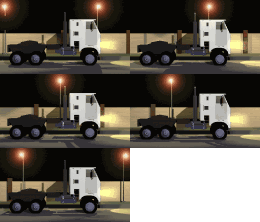
(1A) The intake valve opens and air is forced into the cylinder by boost pressure from the turbocharger.
(2A) Air is compressed to approximately 500PSI by the engine piston. The energy required to compress this air is produced by the vehicle's driving wheels. Near top dead center, the Jacobs Engine Brake® opens the exhaust valves, venting the high pressure air and dissipating the stored energy through the exhaust system. (3A) On the downward stroke, essentially no energy is returned to the piston (and to the driving wheels). There is a loss of energy. This loss is how the retarding work is done. Jacobs Vehicle Systems - How the Jake Brake Works I was told that the myth of engine wear comes from someone that did not like the noise generated by the brake in use. In order to try to get he drivers to reduce the use of the brake, "You'll wear out your engine prematurely". The fact is that you do not put any more "load" on the engine than normal use. As a matter of fact, you put MORE load on the engine when climbing a hill, because you have far more pressure in the combustion chamber when the fuel ignites than you do simply from bringing the piston up to the top of compression. This increases the load on the connecting rods and all crank journals.
__________________
( R E T I R E D , and glad of it)
YES ! ! ! There is life after trucking. a GOOD life
#5
05-14-2010, 08:25 AM
I was hoping I was on the right track. I took a 'leap of faith' on this one. :lol: I remember someone telling me one time how they work.
#6
05-15-2010, 12:04 AM
I keep my Jake's on all the time unless I am in a truck stop parking lot. It saves my brakes and I have almost 1 million miles on one truck and have never had a problem with the engine from the Jake's.

#7
05-15-2010, 12:21 AM
The only time a Jake brake will hurt an engine is if the driver gets stupid and allows the weight of the truck going downhill to push the engine RPM's over the engine's maximum RPM limit.
Then again, letting the engine get pushed past maximum RPM will also cause damage without the Jake brake on. .
__________________
If you can't shift it smoothly, you shouldn't be driving it.
#8
05-15-2010, 02:16 AM
the problem is they were talking about a Jake "Break" which would obviously break something, however, a Jake Brake should be fine
:moon:
__________________
http://fredogtrucking.proboards.com
#9
05-15-2010, 02:57 AM
I know I don't have to wory about you g but to others, even with the jakes, use the corect gear and have that foot ready to stomp that brake if you have to. I've had a few trucks where the jakes didn't engage. Once comming down cabage and once on fancy gap. That could have been interesting if I didn't have it in the right gear, lol
__________________

#10
05-15-2010, 09:58 AM
I was told that with my 1.4 mil miles, the reason my pistons looked good was because I have no jake & if I did, my pistons would be in worse shape if not needed replacement sooner.
|