
Flatbeds and Tiney Chains
Subscribe
#21
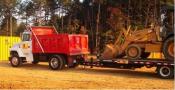
Mr. Ford95 , 07-03-2011 02:06 AM
 04-21-2019
Thank you gpc, that pic was taken when things were going good and right after I had done a wash and wax on it. Now the truck doesn't look so good from sitting. I normally do very little rock hauling with it, it's mostly used for moving equipment.
#22
Quote:
You'll have to excuse me and my comprehension defecit but I'm not seeing it/reading it/comprehending it. I see where you require an total wll of 1/2 the weight you're securing (too little imho) but I am not seeing where it says if I hook a binder to a piece you are securing that because you hooked the binder to the piece and not a chain the wll of the binder is reduced by 50%.Originally Posted by GPC
Here we go.
#23
Quote:
Mgfg the part hilighted is what you are looking for.Originally Posted by mgfg
You'll have to excuse me and my comprehension defecit but I'm not seeing it/reading it/comprehending it. I see where you require an total wll of 1/2 the weight you're securing (too little imho) but I am not seeing where it says if I hook a binder to a piece you are securing that because you hooked the binder to the piece and not a chain the wll of the binder is reduced by 50%.
Quote:
1.1. One-half the working load limit of each tiedown that goes from an anchor point on the vehicle to an attachment point on an article of cargo;
This is saying that any direct contact tiedown (such as a binder going from directley from the side of trailer to the machines track) will be rated at half it's working load limit.1.1. One-half the working load limit of each tiedown that goes from an anchor point on the vehicle to an attachment point on an article of cargo;
Quote:
2.2. The working load limit for each tiedown that goes from an anchor point on the vehicle, through, over or around the cargo and then attaches to another anchor point on the vehicle.
This is saying that any indirect contact with the piece of equipment (such as a binder and chain going from one side of the trailer through a tiedown point on the machine to the other side of the trailer with out ever being directly hooked to the machine) will be worth the whole wll of ethier the binder or chain. Which ever is less.2.2. The working load limit for each tiedown that goes from an anchor point on the vehicle, through, over or around the cargo and then attaches to another anchor point on the vehicle.
#24
How obscure...Thanks (I think) GPC.
That's bizarre! Now I have to re-think some of my load securement or risk some DOT zealot busting me for this.
I wonder what the logic is behind this? What does it matter it a binder secures a piece directly (direct contact) or not? Would a hook and two links of chain make that much difference?
That's bizarre! Now I have to re-think some of my load securement or risk some DOT zealot busting me for this.
I wonder what the logic is behind this? What does it matter it a binder secures a piece directly (direct contact) or not? Would a hook and two links of chain make that much difference?
#25
393.106 (d)
(1) this section is saying from deck to object is 1/2 WLL. trailer-binder-object 1/2
(2) this section says from deck, over, around, or though and back to the same side of deck is also 1/2 WLL driver side trailer - chain - object- chain- binder- driver side 1/2
(3) this says driver side over, though or around object to passenger side is Full WLL left side -chain- object- chain- right side Full Wll
Here's a pic I drew of 1, 2 and 3. 1 and 2 are considered direct securement. 3 is indirect securement. 1 and 2 are directly pulling on the object, which are not putting and equal force downward on the object. 3 is indirectly pushing down on the object. It is doing more work then 1 and 2 therefore it gets full WLL.
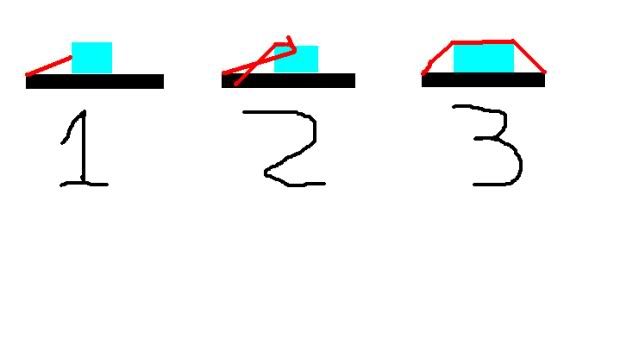
(1) this section is saying from deck to object is 1/2 WLL. trailer-binder-object 1/2
(2) this section says from deck, over, around, or though and back to the same side of deck is also 1/2 WLL driver side trailer - chain - object- chain- binder- driver side 1/2
(3) this says driver side over, though or around object to passenger side is Full WLL left side -chain- object- chain- right side Full Wll
Here's a pic I drew of 1, 2 and 3. 1 and 2 are considered direct securement. 3 is indirect securement. 1 and 2 are directly pulling on the object, which are not putting and equal force downward on the object. 3 is indirectly pushing down on the object. It is doing more work then 1 and 2 therefore it gets full WLL.
#27
It helps when it was explained to me, as direct and indirect, inside a scale house. He was nice enough to draw me a picture to explain what he ment. Put me OOS for exceeding WLL, and let the tires with cords showing slide. Slapped some more binders on, and away down the road I went. The first thing they see in the scale are lights, and your securement. Because of him, I over kill on securement, and make damn sure my tires are good, in the spring, no less than 4/32nds for me anywhere on the rig.

